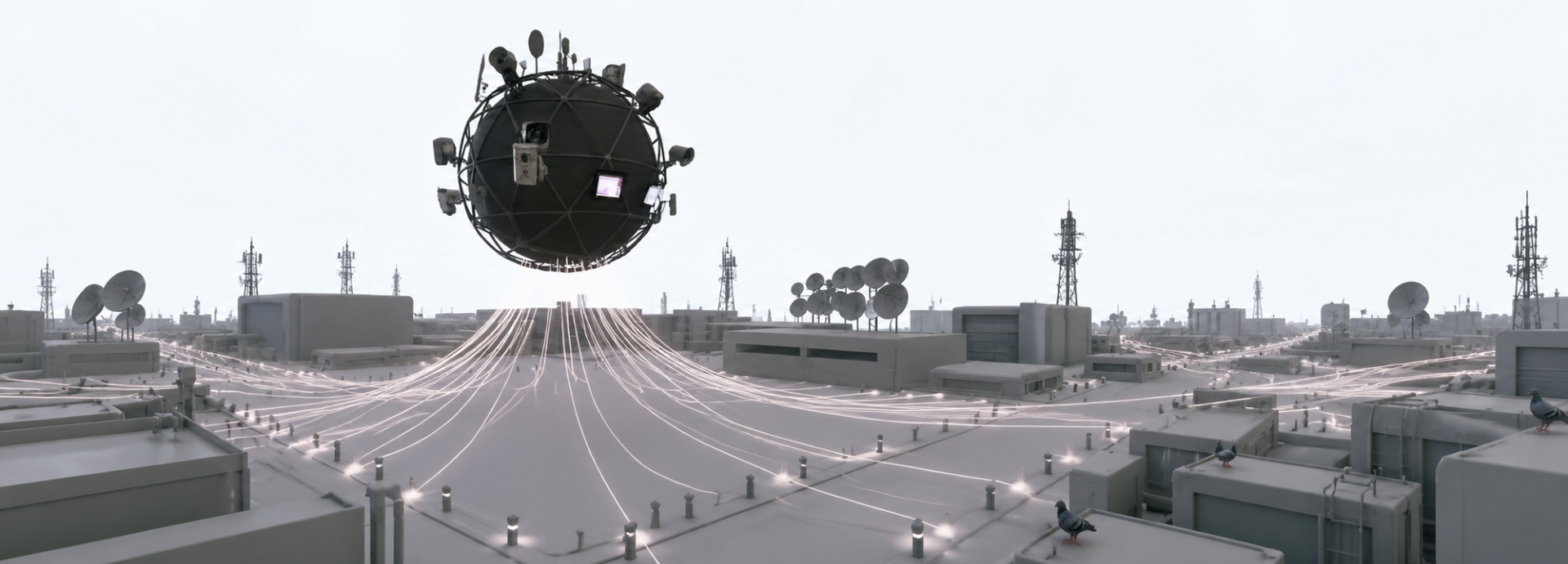
Eternal Terra Ear: Audit the Geometry/Terrain of Governance for PeaceBuilding
When physical AI, smart-city digital twins, and autonomous administrative systems are deployed into shared environments, they alter the conditions of public life. Whether manifested as a pedestrian yielding to an autonomous delivery robot, an asylum seeker classified by border verification models, or a displaced community cut off when cloud infrastructure fails, automated systems constantly enforce boundaries of risk and authority.
Eternal Terra Ear bridges critical spatial theory, geometric topology, and civic tech audit to unpack this invisible terrain. The day combines artistic inquiry with rigorous systemic auditing: speculative world models and digital installations reveal the lived atmosphere, asymmetry, and forced adaptation created by automation, while researchers and participants translate these insights into concrete questions, testable claims, and contestable civic evidence.
Core Inquiry: The Four Civic Scenarios
Audience members choose a shared space that directly matters to them to conduct a situated civic audit:
- Urban: Autonomous machines, digital twins, zoning, sensing, and public movement.
- Internet: Rage bait, coordinated bots, recommender dynamics, and algorithmic attention economies.
- Sovereign: Digital identity, algorithmic border management, automated eligibility, and institutional appeal.
- Humanitarian: Crisis infrastructure, displacement, degraded networks, and local civic autonomy.
The Shared Audit Grammar
Working with ÉTÈ’s open audit worksheets, breakout groups evaluate systems across three modalities (Safety, Ethics, and Aesthetics) using five diagnostic anchors:
- 01 Situation: Where does the system meet shared life?
- 02 Actors: Who can act, classify, refuse, appeal, or leave—and who is excluded from those powers?
- 03 Pressure: Who absorbs delay, exposure, silence, displacement, or uncertainty?
- 04 Boundary: What must the system never infer, optimize away, or override?
- 05 Evidence: What record makes an automated decision legible, contestable, and open to public review?
Who Should Attend?
Researchers, artists, digital rights advocates, urbanists, legal theorists, civic technologists, and members of the public interested in algorithmic accountability, spatial justice, and the governance of emerging physical AI. No technical background is required to participate in the audit.
- Please register at
https://www.ici-berlin.org/events/ai-governance-and-audit-nomos/ - Wheelchair accessible.
- Map to the venue: https://www.ici-berlin.org/contact/#map
- Contact general@ete.institute.
Speakers







- Please register at
https://www.ici-berlin.org/events/ai-governance-and-audit-nomos/ - Wheelchair accessible.
- Map to the venue: https://www.ici-berlin.org/contact/#map
- Contact general@ete.institute.
Event Location
ICI Berlin Institute for Cultural Inquiry
Christinenstr. 18/19, Haus 8
10119 Berlin
Germany