Cosmic Games: Real Gods play Dice
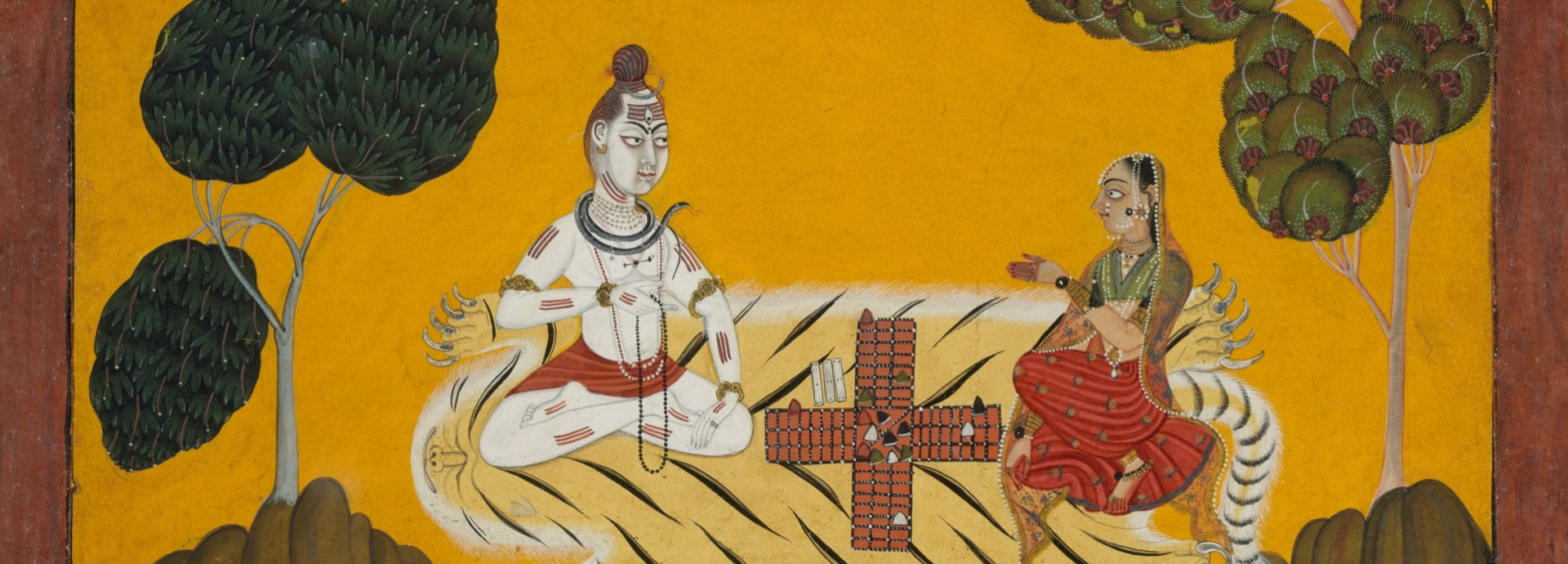
The history of board games can be traced back to the early Bronze Age civilizations of ancient Egypt, Mesopotamia, and the Indus Valley. Associations between games and the cosmos are present from the earliest times and continue to be a popular theme in modern board games! Take for example the journey of the sun through the netherworld in the Egyptian game of Senet, the movement of the planets through the zodiac in the Babylonian Game of Twenty, the astral and calendrical symbolism of the Persian game of Nard, and the modelling of cosmos and karma in the Indian game of Chaupar. In fact, Chaupar survives in a simplified version known to German children and adults alike as Mensch ärgere Dich nicht.
While traditional board games such as Chess, Go, and Backgammon are commonly considered abstract and detached from everyday reality life, exploring the histories of board games reveals connections to many aspects of social life—from science and religion to art and leisure. And not merely as visual objects and symbolic representations, but as models of the universe used to understand the inner workings of the cosmos and predict its influence over the fates of those inhabiting it.
This interactive exhibition gives you the possibility to play traditional board games associated with cosmological representations from different cultures and societies across the world. The games will rotate throughout the exhibition, allowing you to return to the stand and experience new games throughout the course of the weekend.
Through objects, posters, and multimedia you will also get to learn about the diversity of sources involved in historical game research, from manuscripts to paintings to dice.
Keen to learn even more? Board game historian Jacob Schmidt-Madsen will run special sessions of larger games with multiple participants! Researchers will also be present at the exhibition to answer your questions about the field of board game studies or even pursuing your own historical research.
The German mathematician and philosopher Gottfried Wilhelm Leibniz (1646–1716), who was among the first Europeans to engage with games scientifically, insisted that they were worthy of study “not for their own sake but for the sake of discovering new fields of knowledge” (“Note on Certain Games”, Berlin, 1710). It is in this spirit of discovery that we invite you to learn about and engage with traditional games as sites of performative astronomy and astrology.
- CAMPUS exhibition stand.
- Free entry.
- Wheelchair accessible.
- More accessibility information available here.
- CAMPUS exhibition stand.
- Free entry.
- Wheelchair accessible.
- More accessibility information available here.