The Red Queen Effect
At the heart of the exhibition The Red Queen Effect lies a paradox: While artificial intelligence (AI) promises medical advances and breakthroughs, it constantly raises the stakes for those trying to keep up with these developments. kennedy+swan addresses social and ethical issues raised by the increasing use of AI in medicine. Faster diagnoses and more precise treatments that allegedly lead to healthier and longer lives shape individual and collective expectations, fears, and imaginations. AI systems are, however, embedded in existing social, political, and economic structures. The exhibition reveals how they are never a neutral solution: visions and promises surrounding AI are shaped by those who design, supervise, and imagine it as a future cure-all.
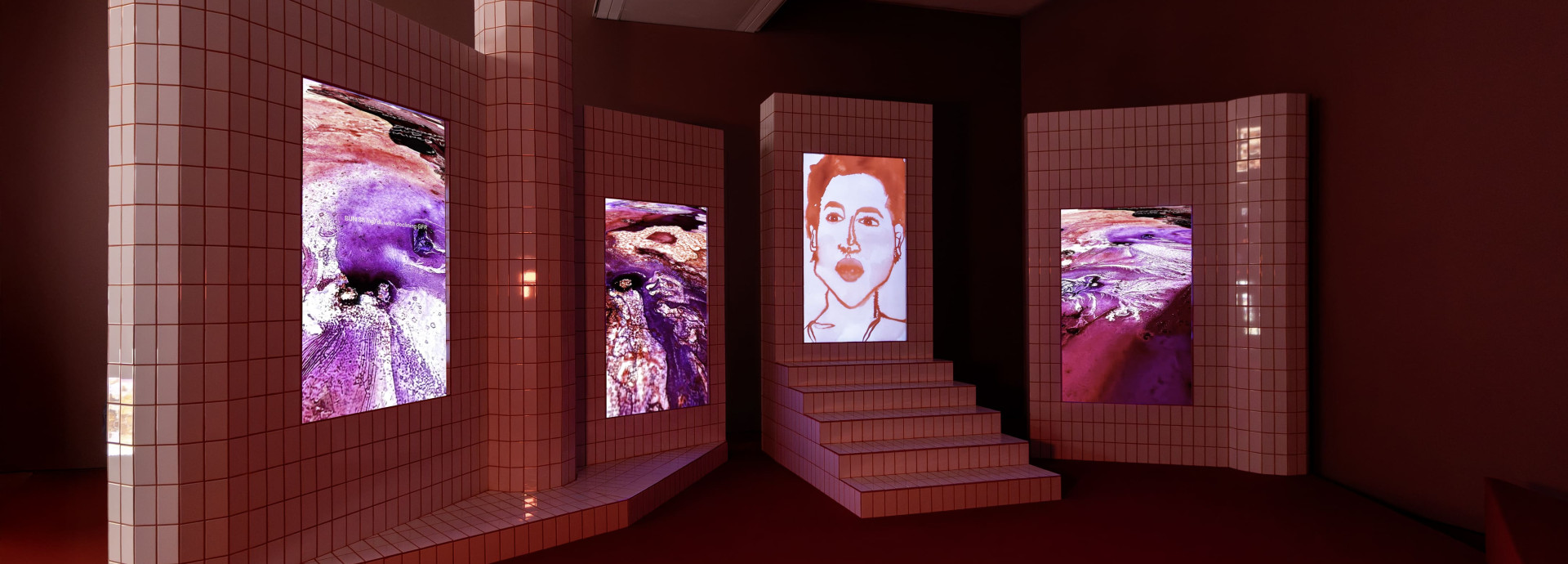
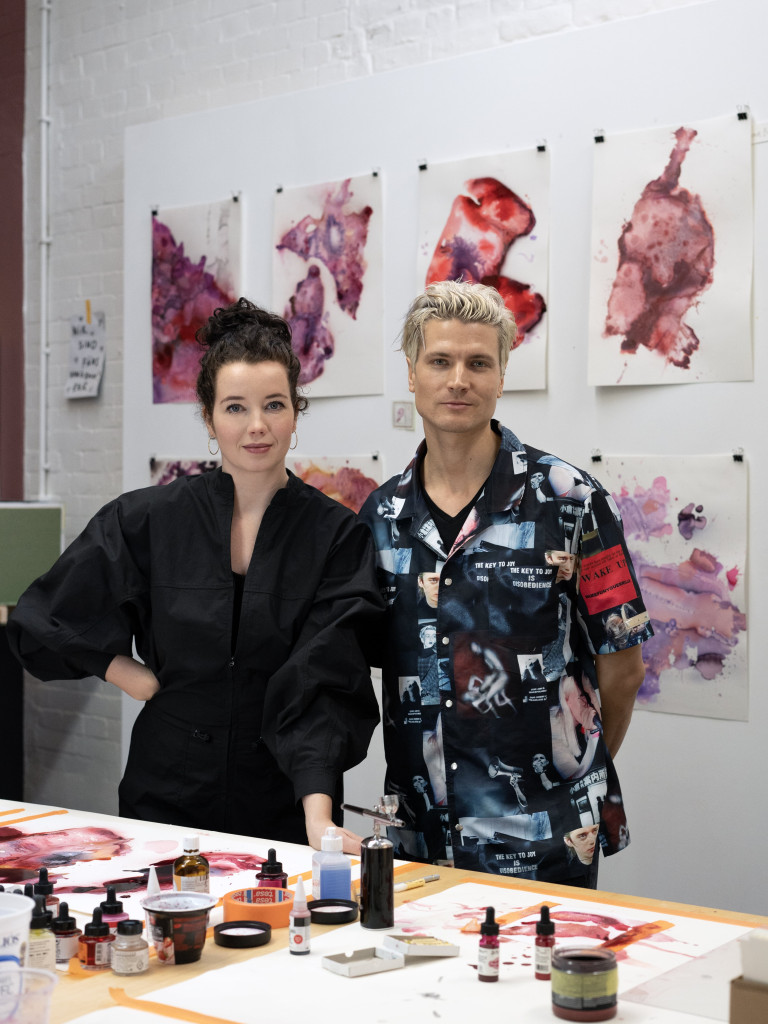
The Red Queen Effect¹ consists of two parts. First, a four-channel video work takes us into a fictional health-care startup ALICE. The company offers medical services and products – initially for a group of volunteers. The film addresses the contradictory views (and expectations) provoked by the promises of AI-based health services. Second, the work series titled Lung Portraits consists of 12 light boxes. Watercolors on glass, which have been treated with chemicals, form the starting point for the aesthetic intervention that explores an AI model specialized in recognizing lung cancer from tissue scans. The artist duo developed the works as part of the Art of Entanglement fellowship, which was awarded in 2024 by the Schering Stiftung and the Berlin Institute for the Foundations of Learning and Data (BIFOLD).
The Lung Portraits imitate microscopic specimen. Together with experts from BIFOLD, scans of the watercolors were used in an experiment and fed into the AI system. The system accepted the artistic works as medical images and found “an (…) origin of micropapillary breast carcinoma” in one of them. These and other diagnoses were transferred onto the watercolors by the artists using laser engraving. This experiment shows that many systems tend to provide seemingly plausible diagnoses rather than admit uncertainty. kennedy+swan question the systems’ reliability in case of incomplete or imprecise datasets.
In the video piece developed for the exhibition, the artist duo introduces ALICE. 22 volunteers apply for clinical trials of ALICE’s health-improvement products and processes. The volunteers range from individuals who are deeply engaged with health-related issues to transhumanists and skeptical activists. But perhaps more importantly, they embody the spectrum of emotional responses to the new AI-based health technologies: fear, excitement, skepticism, hope, and dependency. This becomes clear in a series of interviews between the company and volunteers, whose faces are obfuscated by turning them into animated watercolor portraits.
¹The title refers to the figure of the Red Queen in Lewis Carroll’s novel Through the Looking-Glass, and What Alice Found There. The Red Queen explains to Alice that she has to run as fast as she can to stay in the same place. In evolutionary biology, the so-called “Red Queen Effect” describes a hypothesis of evolutionary adaptation proposed in 1973. According to this hypothesis, species must constantly evolve or adapt to survive in a changing environment.
The exhibition runs from 11.09. – 12.12.2025 at Schering Stiftung.
- Free entry.
- Wheelchair accessible (except toilets).
Speakers
- Free entry.
- Wheelchair accessible (except toilets).